


Stella Juva, the world’s first solar-powered ambulance developed by a team of students in the Netherlands, has completed more than 800 kilometres of testing across Kenya, successfully demonstrating that it can travel through difficult terrain while generating enough solar energy to operate medical equipment in areas without electricity.
The vehicle was developed by Solar Team Eindhoven, a 23-member student team from Eindhoven University of Technology and partner institutions. It was tested in Kenya in August in collaboration with Amref Health Africa, with the aim of determining whether the technology could deliver healthcare in communities where electricity, fuel and reliable roads are limited.
The trial took Stella Juva through several locations in Kenya, including the remote areas of the East African country not connected to the power grids. The journey included long stretches of rough, unpaved roads. At one point, the team spent about six hours travelling to reach a remote field location.
Despite the conditions, the vehicle completed the journey with only a minor mechanical problem reported. A broken steering rod was replaced in about 30 minutes, after which testing continued. But the most important test was not simply whether Stella Juva could move.

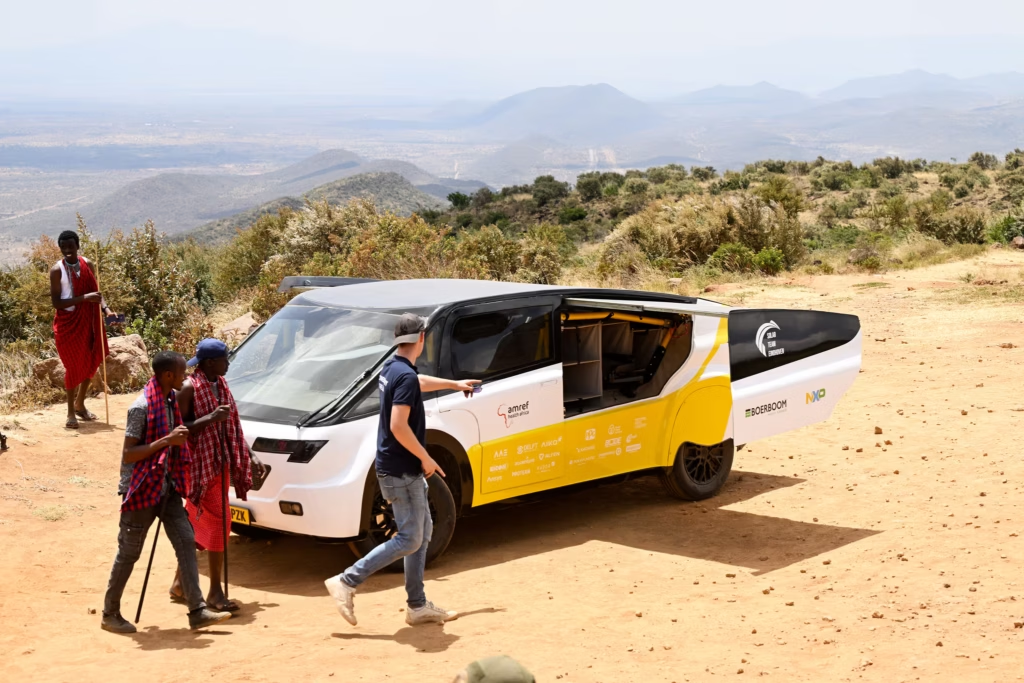
Unlike a conventional ambulance, the vehicle is designed primarily to take medical services to patients rather than transport patients to hospitals. Its equipment includes an X-ray machine, ultrasound scanner, automated external defibrillator, vaccine refrigeration and other diagnostic equipment.
That distinction matters in parts of Africa where distance and infrastructure remain major barriers to healthcare. Amref says around a third of Africans live more than two hours from health services, while many rural health facilities face unreliable electricity supplies. Stella Juva addresses both problems through its energy system.
Solar panels integrated into the roof generate electricity while the vehicle is moving, while additional panels can be extended when it is stationary. The stored energy can then be used to operate the vehicle and its medical equipment. During a two-day healthcare simulation with Amref, the vehicle generated more solar energy than its medical equipment consumed while stationary, even when the onboard equipment was operating simultaneously.
The team estimates that the equipment could have supported healthcare services for about 200 people over two days. No real patients were treated during the trial.
Stella Juva can reach a top speed of about 120 kilometres per hour and was initially estimated to have a sunny-day range of roughly 715 kilometres. Its battery allows the vehicle and medical equipment to continue operating after sunset or during cloudy conditions.


The project is particularly relevant to Kenya because many remote communities combine long distances with difficult terrain and limited infrastructure. A vehicle that can travel without depending on fuel stations or a grid connection could potentially support mobile clinics, maternal healthcare, diagnostics, vaccination programmes and emergency services in such areas.
The concept also builds on Solar Team Eindhoven’s earlier experiments with solar mobility, including Stella Terra, an off-road solar vehicle. Stella Juva applies that engineering experience to healthcare, with the students specifically targeting communities where conventional transport and energy infrastructure can make medical outreach expensive and difficult.
However, Stella Juva remains a prototype, not a commercially available ambulance. The students have said scaling the technology will require collaboration with manufacturers, healthcare organisations and industry partners.
The successful Kenyan trial therefore represents more than a technological demonstration. It provides evidence that solar-powered mobility can be combined with medical equipment in demanding real-world conditions.
Stella Juva points to a different way of thinking about healthcare delivery, especially in the global south, where healthcare facilities can be separated by vast distances and reliable electricity is not guaranteed, bringing the equipment and energy needed for basic diagnostics and treatment directly to communities rather than making every patient travel to a hospital.


